

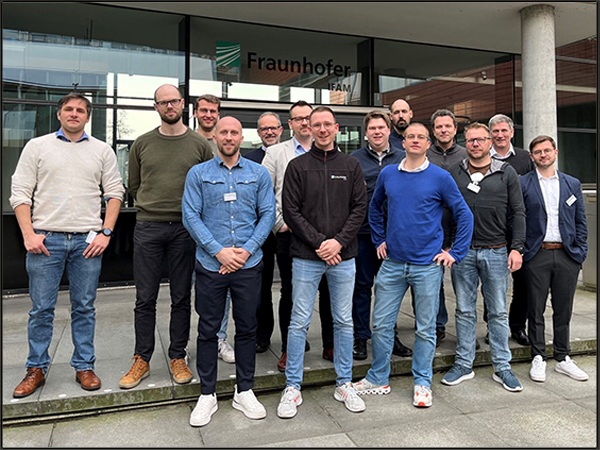
Raw material manufacturers, paint manufacturers, and paint processing companies continuously collect material and process data. However, this data is currently neither shared nor correlated. It is also unclear whether the currently collected data even allows for the creation of valid predictive models. The broad scope of the consortium in the Na, Logisch project can close a potential data gap and enable the development of valid predictive models. The partners PI Probaligence, in collaboration with the Niederrhein University of Applied Sciences, already demonstrated the fundamental feasibility of this in March 2022. Sections of a high-throughput system were optimized using AI.
Currently, there is no standardized data exchange along the value chain in paint technology, meaning that the basis for the use of digital technologies in this sector is either nonexistent or only partially present. A “trial and error” process is therefore the state of the art in paint development, production, and processing. This process, the “error,” leads to comparatively high reject rates in paint development and production. Paint manufacturers generate between 5 and 30 tons of paint waste per year (depending on production volume). Complex formulations involving more than one raw material are virtually impossible to replace in these processes while maintaining consistent system performance. This results in enormous formulation effort in the laboratory, which is often not undertaken due to resource constraints and limited R&D hours.
Similarly, in paint processing, painting processes must be stopped until the desired finish is achieved. With complex painting systems, this process can take several months. Components produced up to that point are declared scrap.
In the work package description, this value chain is divided into two sections. Value chain 1 relates to paint formulation and production. Value chain 2 relates to paint application and its correlation with the appearance of the painted surface.
It is important to note that painting processes are particularly energy-intensive. For example, 40% of the total primary energy consumption in automotive production is attributable to the painting process (baking). If the properties or composition of the paint change over time, for example due to regulations (REACH), following the state-of-the-art paint development process will result in painting defects and time-consuming adjustments to the paint system. The Na, Logisch project is creating a digital paint twin that will help apply paints efficiently with fewer adjustment attempts in the future. The digital technologies developed in the Na, Logisch project will be made available to German paint manufacturers and the paint-processing industry. This will enable paint manufacturers across Germany to avoid up to 2,000 tons of paint waste and produce digital, smart paints in the form of a digital twin. In addition, the use of renewable raw materials will be made possible, and development times will be significantly reduced. The paint-processing industry will use the predictive models to adjust the painting process and minimize reject rates. Furthermore, the Na, Logisch project lays the technical foundation for the use of sustainable coating raw materials whose material properties tend to fluctuate significantly, and enables the rapid adaptation of existing formulations while maintaining benchmark quality. This is achieved, for example, through regulations such as REACH regarding CMR substances.