Multifidelity Analysis of a traversed induction hardening device
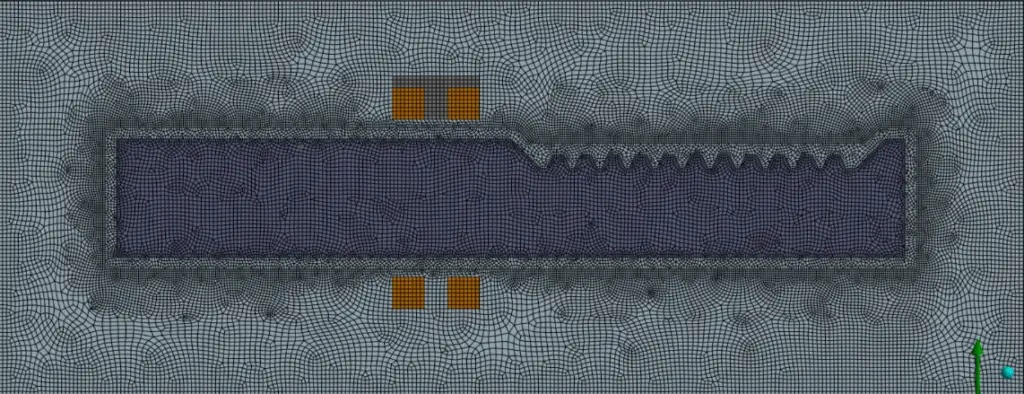
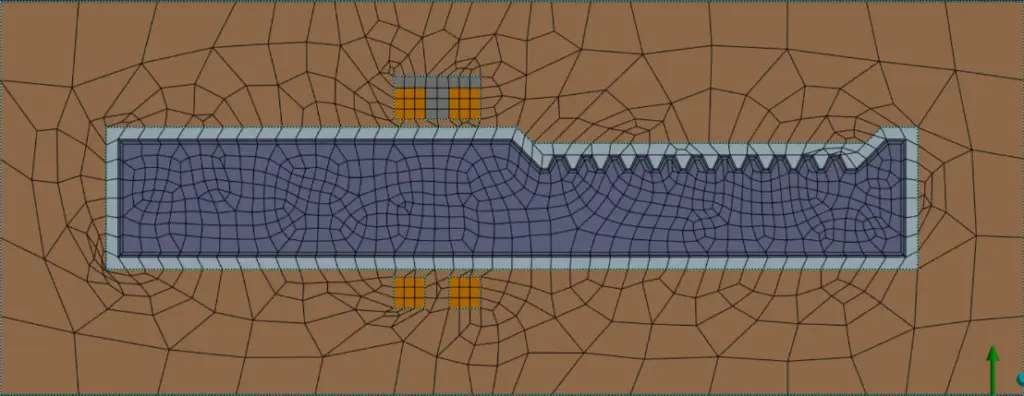
To model the maximum temperature at three points of interest (POIs) during an inductive process, we faced a classic challenge: achieving high-fidelity accuracy (fine grid and temporal resolution) while minimizing computational effort.
Each simulation depends on three parameters across three segments—current, inductor y-offset, and velocity—leading to a complex, high-dimensional design space.
The Challenge
A fully high-fidelity model would require a large number of expensive simulations.
A purely low-fidelity model, while faster, leads to inaccurate and unreliable predictions.
High-fidelity simulations are roughly 7× more computationally expensive than their low-fidelity counterparts.
A direct comparison showed that using only low-fidelity data could lead to temperature prediction errors of up to 40%.
The Solution: Software X and Multifidelity Modeling
By using our multifidelity algorithm in Software X, we combined 20 high-fidelity and 69 low-fidelity simulations (89 total samples) to train a global model capable of accurately predicting high-fidelity temperature outcomes at all POIs.
Software X uses an adaptive Design of Experiments (DoE) approach:
It begins with a small, correlated batch of low- and high-fidelity samples.
A data-driven surrogate model is built.
New sampling points are suggested iteratively, focusing on regions where high-fidelity insight is most valuable.
This strategy ensures that only the most essential high-fidelity simulations are performed, dramatically reducing overall compute time while maintaining prediction quality.
Results
The multifidelity metamodel accurately reproduces the high-fidelity system behavior with an acceptable error rate.
In contrast, a standard ML model trained on the same limited high-fidelity dataset performs significantly worse.
This validates our approach: Exploiting low-fidelity to explore high-fidelity behavior efficiently and reliably.